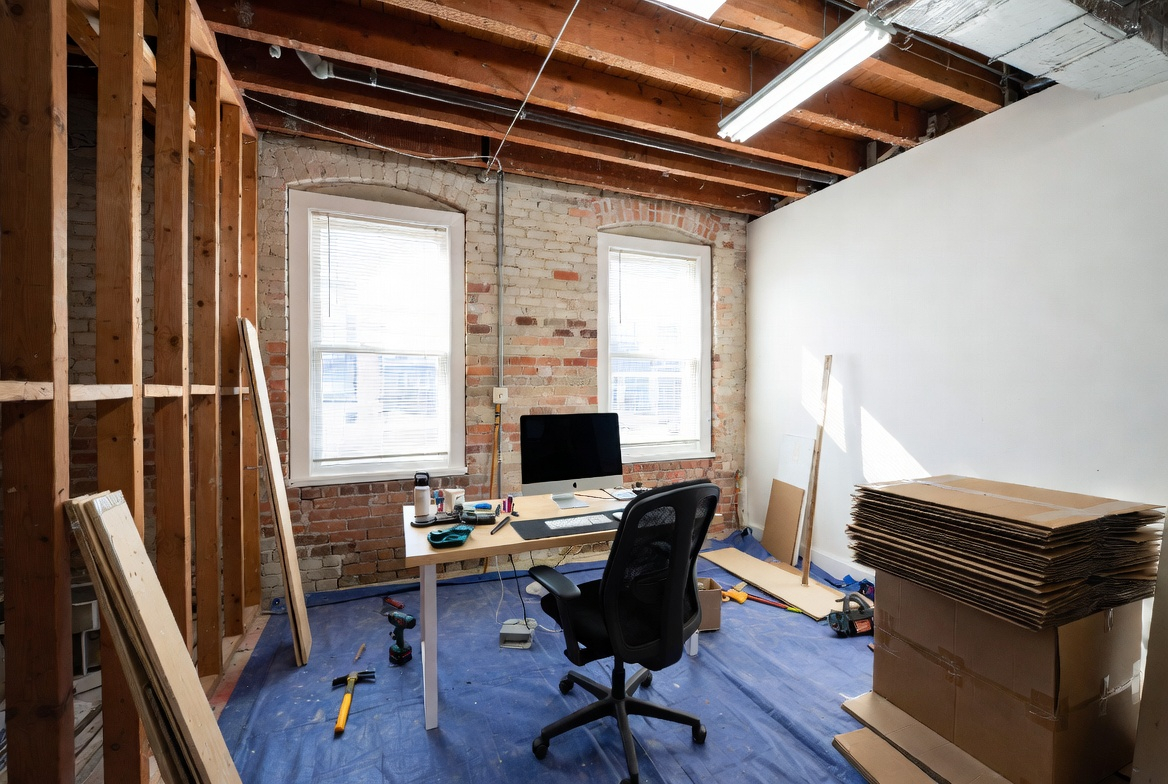
The office renovation market in the UK has reached an inflection point. Hybrid working has permanently changed what an office must do. Rising costs, sustainability expectations, and a post-pandemic war for talent mean that a renovation done without a clear brief and proper professional guidance can haemorrhage budget and still fail to deliver a workspace that works. This guide tells you everything you need to know before committing a penny.
Whether you are an SME fitting out your first proper space, a property manager overseeing a commercial refurbishment, or a home office owner wanting a high-quality dedicated workspace, the fundamentals are the same: know your costs, understand what drives them, choose the right contractor, and build in a contingency.
We cover what UK businesses are searching for and demanding in 2026, the full cost breakdown by specification and region, the biggest design trends worth understanding, what goes wrong — and the practical steps that separate a successful office renovation from an expensive disappointment.
What UK Businesses Are Actually Asking For in 2026
The data from search analytics and industry surveys tells a consistent and compelling story: UK businesses are no longer renovating offices to add more desks. They are renovating to give people a genuine reason to come in. The office, post-pandemic, has to justify its existence against the alternative — a well-equipped home setup, no commute, and full autonomy over one's environment.
According to ONS data and the Office for National Statistics Labour Force Survey, over 28% of UK working adults were hybrid working between home and the office in early 2025, a figure that has risen consistently since 2022. This is not a passing phase — it has become structural. And it means the requirements of an office in 2026 are fundamentally different from those of 2019.
Why would anyone commute to this office when they can work at home? In 2026, that is the brief every renovation must answer. The office cannot compete on pure functionality — a home setup handles that. It wins on collaboration, culture, energy, and the things that only happen when people share physical space.
What Businesses Are Prioritising
In Google Trends and search data, UK searches for "office fit out" and "office renovation cost UK" have grown significantly year-on-year since 2022. The most searched-for elements in 2026 include hybrid-ready meeting rooms, hot-desking solutions, breakout areas, and biophilic design elements. "Office renovation cost per square foot UK" remains among the top commercial renovation queries — cost transparency is the primary concern before anything else.
Industry research from Oktra, one of the UK's leading office design and build specialists, confirms that employee engagement is central to every brief they receive. A Gallup study cited in recent workplace research found that companies with genuinely engaged workforces have 17% higher productivity and 21% higher profitability — and the physical environment is increasingly understood as a direct driver of engagement. Businesses are not renovating as a vanity project. They are renovating because their current spaces are a drag on performance and retention.
The Shift From Fixed Desks to Activity-Based Working
The most significant strategic change in UK office design over the past three years is the shift away from assigned seating toward activity-based working (ABW). Rather than every employee owning a desk, ABW environments provide a variety of settings — focus pods for deep work, collaborative project zones, informal social areas, standing desks, quiet libraries, and video-call booths — and employees move between them based on what they are doing that day.
This is not simply a trend. It is a direct response to the reality that hybrid workers only occupy any given desk for a fraction of the week. Fixed desks for a 50-person team that is 60% hybrid on any given day is an expensive waste of space. ABW typically allows a desk ratio of 7:10 or even 6:10 (desks to people), reducing space requirements and freeing up that footprint for the collaboration and wellbeing areas that make the office worth attending.
It is not only commercial offices driving renovation demand. UK Google searches for "home office renovation" and "home office fit out" have grown substantially since 2022. With many professionals permanently working two or more days per week from home, a dedicated, well-designed home workspace has gone from a nice-to-have to an essential productivity tool. The cost of a high-quality bespoke home office in the UK currently runs from £3,000 for a fitted desk and storage solution to £12,000+ for a fully converted room with acoustic panelling, built-in joinery and integrated tech.
Cat A vs Cat B: The Distinction That Controls Your Budget
Before discussing any cost figures, it is essential to understand the industry distinction between Cat A and Cat B fit-out, because the confusion between the two is responsible for more budget shocks in office renovation than almost anything else.
Category A (Cat A)
Cat A refers to the base building state — the shell and core of the office space brought to a habitable but blank condition. A Cat A fit-out typically includes raised access floors, suspended ceilings, a basic mechanical and electrical (M&E) grid including HVAC (heating, ventilation and air conditioning), a lighting grid, electrical distribution, fire detection systems, and blank white-painted walls. It is a clean, empty, functional shell.
Cat A is typically delivered by the landlord as part of a new commercial lease. When a commercial agent advertises a space as "Cat A ready," they mean you are taking on a blank canvas with all the core building services in place. What it does not include is any occupier-specific fit-out whatsoever — no partitions, no branding, no kitchen, no meeting rooms, no furniture.
Category B (Cat B)
Cat B is everything the occupying business does on top of the Cat A shell to make it their own. This is where virtually all of the visible, usable office fit-out occurs: partition walls, meeting rooms, branded decoration, kitchen and breakout areas, server rooms, reception desks, AV systems, furniture, bespoke joinery, acoustic treatments, and any specialist spaces. When a business says they are "renovating their office," they almost always mean a Cat B fit-out — either in a new space they have moved into, or a re-Cat B of an existing office they are refreshing.
If you are fitting out a space from Cat A, budget for Cat B costs only — the core building services are already in place. If you are taking on an older space in a legacy building where M&E systems are outdated, degraded, or absent, you may be facing a full Cat A replacement plus Cat B — which can add 30–50% to total project costs. Always have the M&E condition of any prospective space appraised by a qualified building services engineer before signing a lease.
Shell & Core
In some commercial developments, spaces are available at "shell and core" — below Cat A. This means the structural frame, external envelope, and basic services to the floor plate are in place, but there is no raised floor, no suspended ceiling, no lighting and no tenant M&E. A shell and core to usable office state requires both a Cat A and Cat B fit-out and represents the highest total investment. This level is typically only relevant for businesses taking on a significant floor plate in a new development.
2026 Costs: What You'll Actually Pay
Office renovation costs in the UK in 2026 are best understood as ranges rather than fixed figures. The most reliable industry benchmarks come from specialists including K2 Space, Novex Solutions, Arc Business Interiors, and Oktra. Here is what the market looks like across specification levels.
Cost Per Square Foot by Specification (UK, 2026)
| Specification Level | Cost Per Sq Ft | Cost Per Sq Metre | What's Included |
|---|---|---|---|
| Basic / Cosmetic Refresh | £45–£65 | £480–£700 | Decoration, new flooring, basic furniture replacement, minor electrical updates |
| Mid-Range (Most SMEs) | £65–£95 | £700–£1,020 | Partition walls, meeting rooms, breakout space, branded finishes, AV, furniture |
| High-End / Corporate | £95–£140+ | £1,020–£1,500+ | Bespoke joinery, advanced AV, acoustic treatments, wellness features, high sustainability spec |
| Premium / Flagship HQ | £150–£200+ | £1,600+ | Full bespoke design, premium materials throughout, BREEAM/WELL certification, complete smart building integration |
What Does That Mean in Practice?
| Office Size | Basic Refresh | Mid-Range Fit-Out | High-End Fit-Out |
|---|---|---|---|
| 500 sq ft (small) | £22,500–£32,500 | £32,500–£47,500 | £47,500–£70,000 |
| 1,000 sq ft (SME) | £45,000–£65,000 | £65,000–£95,000 | £95,000–£140,000 |
| 3,000 sq ft (growing business) | £135,000–£195,000 | £195,000–£285,000 | £285,000–£420,000 |
| 10,000 sq ft (corporate) | £450,000–£650,000 | £650,000–£950,000 | £950,000–£1.4M+ |
These cost-per-square-foot benchmarks cover construction and fit-out only. They do not include furniture (budget separately at £12–£35 per sq ft for quality commercial furniture), IT and network infrastructure (typically £5,000–£25,000+ depending on complexity), professional fees (architect, project manager, structural engineer — typically 8–15% of construction cost), and your contingency (always 15–20%). A mid-range 1,000 sq ft fit-out at £70,000 construction cost could total £95,000–£110,000 fully fitted and equipped.
Furniture Costs
Furniture is one of the most significant and most frequently underestimated cost categories. The range is wide: a basic desk-and-chair setup costs £300–£600 per workstation; a quality ergonomic setup with task chair, sit-stand desk, and monitor arm runs £800–£1,500; premium workstations can exceed £2,000. Meeting room tables and chairs, breakout sofas, reception furniture, kitchen units, and storage add further cost. A realistic furniture budget for a mid-range 20-person office is typically £30,000–£60,000.
Technology and AV Costs
Modern offices require a meaningful technology investment. Video conferencing systems for meeting rooms cost £3,000–£15,000 per room depending on specification. Structured cabling and network infrastructure for a 20-person office typically runs £8,000–£20,000. Smart building controls, occupancy sensors, and integrated audio-visual systems add further cost. A realistic all-in technology budget for a 20-person SME office is £15,000–£40,000.
Regional Cost Differences Across the UK
Location is one of the most significant factors in office fit-out costs, driven by differences in labour rates, logistics, and local market conditions. London consistently commands a premium of 20–40% over equivalent work in other UK regions.
| Region | Basic Refresh | Mid-Range | High-End | vs. UK Average |
|---|---|---|---|---|
| Central London | £65–£85/sq ft | £85–£120/sq ft | £120–£175/sq ft | +25–40% |
| South East / M25 | £55–£75/sq ft | £75–£105/sq ft | £105–£150/sq ft | +15–25% |
| Manchester / Leeds | £45–£65/sq ft | £65–£90/sq ft | £90–£130/sq ft | UK average |
| Birmingham / Midlands | £42–£62/sq ft | £62–£88/sq ft | £88–£125/sq ft | −5–10% |
| Glasgow / Edinburgh | £42–£60/sq ft | £60–£85/sq ft | £85–£120/sq ft | −8–12% |
For Glasgow and Scottish businesses specifically, the combination of lower land costs, strong local supply chain, and competitive labour market means that mid-range office fit-outs are meaningfully more affordable than equivalent work in the South East — without any sacrifice in quality when working with properly vetted local specialists.
The 2026 Design Trends That Are Worth the Investment
Not every design trend belongs in a realistic renovation budget. Here are the ones that consistently deliver real value — whether measured in productivity, talent retention, wellbeing, or long-term operating cost.
Biophilic Design
Living walls, natural materials, maximised daylight and greenery. Research shows consistent productivity and wellbeing improvements. Has moved from luxury to near-standard in mid-range fit-outs.
Hybrid-Ready Layouts
Hot-desking stations, 'Teams-ready' meeting rooms with good acoustics and integrated AV, and touchdown spaces. Non-negotiable in 2026 for any multi-person office.
Acoustic Design
Poor acoustics is the top post-renovation workplace complaint. Sound-absorbing panels, acoustic pods, and zone separation. Budgeting for this upfront costs far less than retrofitting.
Sustainable Fit-Out
Low-VOC finishes, recycled materials, LED lighting, smart HVAC. Now standard practice, not a premium add-on. Reduces operating costs and supports ESG commitments.
Wellness Spaces
Dedicated quiet rooms, mindfulness zones, ergonomic furniture and movement-encouraging layouts. Reducing sedentary work is both a wellbeing and productivity goal.
Smart Technology Integration
Occupancy sensing, adaptive lighting, integrated air quality monitoring and AI scheduling tools. Emerging as embedded infrastructure rather than optional add-ons in 2026.
Biophilic Design: The Trend With the Best ROI
Of all the 2026 trends, biophilic design — integrating nature, natural materials, daylight and greenery into the workspace — consistently delivers the highest measurable return. Research from multiple independent studies confirms that biophilic environments reduce perceived stress and enhance cognitive function. For businesses investing in office renovation primarily to improve talent retention and productivity, biophilic elements represent an excellent allocation of renovation budget.
In practical terms for a mid-range UK fit-out, this means maximising natural light through thoughtful layout planning, specifying timber finishes and natural stone surfaces, incorporating indoor planting strategically at key circulation points, and — where budget allows — installing a living wall or green installation as a focal point. A well-executed biophilic feature installation costs £3,000–£12,000 and delivers visible, lasting impact.
The Acoustic Problem Nobody Talks About Until It's Too Late
Acoustic performance is the most consistently underspecified aspect of office renovation — and the most complained-about outcome once people move in. Open-plan offices designed for collaboration become unbearable for focused work without proper acoustic management. In 2026, with hybrid workers attending video calls from the office alongside colleagues in open-plan settings, the acoustic requirements are more demanding than ever.
Proper acoustic design is not about installing one phone booth and calling it done. It means zone separation with appropriate acoustic mass between areas, sound-absorbing ceiling panels in open areas, acoustic glazing on meeting rooms, and dedicated quiet zones with appropriate sound isolation. Budget for this in your initial design, because retrofitting acoustic treatment after a fit-out is expensive and rarely as effective as designing for it from the start.
Gallup research cited across multiple industry sources finds that organisations with engaged workforces are 17% more productive and 21% more profitable. The physical work environment is one of the most direct and controllable inputs to engagement. A well-designed office is not a cost — it is one of the highest-return investments a business can make in its people.
Timeline: How Long Does an Office Renovation Take?
The gap between when a business decides to renovate and when they move into a finished space is consistently longer than people expect — and rushing any phase is one of the most reliable ways to inflate cost and reduce quality.
| Phase | Duration | Notes |
|---|---|---|
| Brief development & design | 3–6 weeks | Workplace appraisal, space planning, concept design. Rushing this phase leads to mid-project changes that cost significantly more than time spent upfront. |
| Contractor selection & quotation | 2–4 weeks | Obtaining 3+ competitive tenders, evaluation, negotiation, and appointment. Do not skip competitive tendering — even on projects with a preferred contractor. |
| Landlord consent (if required) | 2–6 weeks | Drawing and specification submission, landlord review, legal correspondence. Can be done in parallel with contractor selection. |
| Procurement of long-lead items | 6–14 weeks | Bespoke furniture, custom joinery, specialist AV, acoustic products. Must be ordered before or immediately upon contractor appointment. |
| Construction / fit-out on site | 6–12 weeks (SME) 10–16 weeks (corporate) |
Actual build programme depends on size and complexity. A typical 1,000 sq ft SME fit-out runs 6–8 weeks; a 10,000 sq ft corporate project runs 10–12 weeks. |
| Snagging & completion | 1–2 weeks | Thorough snagging list, contractor resolution of all items before final payment release. |
Total project duration: For a 1,000 sq ft SME fit-out, allow 4–5 months from first decision to moving in. For a 5,000–10,000 sq ft corporate project, allow 6–9 months. These timelines cannot be safely compressed without accepting higher cost or lower quality.
Planning Permission & Building Regulations: What You Need to Know
The planning and regulatory requirements for office renovation are different from domestic projects — and confusion in this area can lead to enforcement action, abortive costs, and significant delays.
When You Do NOT Need Planning Permission
Internal works to an existing office space that do not alter the building's external appearance and do not change its use class generally do not require planning permission. A standard Cat B fit-out — partitioning, decorating, fitting out meeting rooms, installing kitchen units — within an existing office building will not require a planning application.
When You DO Need Planning Permission
Planning permission is required when you change the use class of a building (for example, converting offices to residential use, which is subject to specific permitted development rights under Class MA introduced in 2021 but with local authority conditions), when making material changes to the external appearance of a building, or when the property is listed or in a conservation area. Any structural alterations also require Building Regulations approval.
Planning regulations in Scotland operate under Scottish planning law, which differs in several respects from England and Wales. Permitted development rights in Scotland are set out in the Town and Country Planning (General Permitted Development) (Scotland) Order 1992 (as amended). If your office is in Glasgow, Edinburgh, or elsewhere in Scotland, the rules may differ from what applies south of the border. Always verify with your local authority or a qualified planning consultant.
Building Regulations Always Apply
Regardless of whether planning permission is required, all office renovation works that are structural, that affect fire safety systems, that involve new electrical installations, or that alter drainage, ventilation or insulation must comply with Building Regulations. Fire escape routes, fire compartmentation, structural alterations and new electrical circuits must all be designed and signed off to the relevant Building Regulations standards. Work should be carried out by suitably qualified and registered contractors — electrical work by an NICEIC or ECA registered firm, structural work with appropriate structural engineer sign-off.
Asbestos
Any building constructed before 2000 may contain asbestos-containing materials (ACMs). Before commencing any renovation works in such a building, a management or refurbishment asbestos survey must be completed by a licensed surveyor. Disturbing ACMs without proper management and removal procedures is a criminal offence under the Control of Asbestos Regulations 2012. This is non-negotiable and the surveyor's report must be available to all contractors before works begin.
The Most Common Mistakes — and How to Avoid Them
In September 2024, ISG — one of the UK's largest fit-out and construction contractors, with over £2 billion in annual revenue — entered administration. Projects across the country were stranded mid-construction. Businesses lost deposits, faced delayed moves, and in some cases sustained significant financial losses. ISG's collapse was not an isolated event: contractor financial instability has been one of the defining risks of the UK commercial fit-out market since 2022.
Industry commentary, Cushman & Wakefield Office Fit Out Cost Guide 2025
The most consequential mistakes in office renovation, in roughly descending order of financial impact:
-
Not checking contractor financial stability. ISG's 2024 collapse is the most prominent recent example, but contractor insolvency has been a consistent feature of the post-pandemic construction market. Before appointing any contractor, request their most recent filed accounts, check their credit rating, and ensure appropriate retention is structured into the payment schedule. A contractor going into administration mid-project can leave you with an incomplete office, a disputed deposit, and a programme set back by months.
-
Rushing the brief and design phase. Changes made during construction cost 3–10x more than changes made during design. Every hour spent developing a clear, comprehensive brief before a contractor is appointed saves multiple hours of abortive work and rework later. Do not start on site until the design is complete and sign-off from all stakeholders has been obtained.
-
Underestimating M&E condition. The condition of existing mechanical and electrical services is the single biggest source of cost surprises in office renovation. An M&E condition survey (cost: typically £1,500–£5,000) is the best money you can spend before committing to a space or a budget. A building with degraded HVAC, undersized electrical distribution, or outdated fire systems can add hundreds of thousands of pounds to a fit-out budget.
-
Late procurement of long-lead items. Bespoke furniture, custom joinery, specialist AV and acoustic products with 8–14 week lead times must be ordered at or before the point of contractor appointment. Ordering late results in your contractor completing structural works and then waiting for furniture — extending programme, increasing preliminary costs, and delaying your move.
-
Ignoring acoustic design. Open-plan offices without proper acoustic management are the most common post-renovation regret in commercial spaces. Budget for acoustic design as a core element — not an afterthought. This means zone separation, acoustic ceiling treatment, soundproofed meeting rooms, and dedicated quiet areas. The cost of doing this properly during the fit-out is a fraction of what it costs to retrofit later.
-
Choosing the cheapest tender. The lowest price rarely represents the best value. Evaluate tenders on contractor track record, financial stability, the quality of their specification, their approach to M&E risk, and their post-completion support. A contractor who is £15,000 cheaper but under-specified on waterproofing, fire stopping or electrical installation can cost multiples of that saving to put right.
Your 8-Step Guide to an Office Renovation That Delivers
-
1
Start with the brief — not the budget
Before a single cost figure is discussed, define what the office must do. How many people? What modes of work? How many are hybrid, and on what pattern? What meetings take place, how often, and of what size? What are the non-negotiables? What does success look like in 12 months? A workplace appraisal conducted with your team produces a brief that drives a better design and a more accurate budget — in that order.
-
2
Commission an M&E condition survey before committing to a space
If you are fitting out a new or existing space, commission a mechanical and electrical condition survey from a qualified building services engineer before signing a lease or approving a budget. The cost is modest. The information is invaluable. Degraded M&E is the most common source of major budget overrun in commercial renovation.
-
3
Appoint your design team before engaging contractors
Whether you use an independent interior designer or the in-house design capability of a design-and-build firm, have a design that is complete — or very close to complete — before inviting contractors to tender. Tendering an incomplete design produces unreliable prices and creates a contractual environment where variations are inevitable and expensive.
-
4
Obtain at least three competitive tenders from financially stable contractors
Request full, itemised tenders from at least three contractors. Verify their financial health (filed accounts, credit check), their relevant project experience, and their references. Ask specifically about their track record on M&E works and their approach to programme management. Do not appoint on price alone.
-
5
Order all long-lead items before confirming a start date
Bespoke furniture, custom joinery, AV systems and acoustic products must be on order — with confirmed delivery dates — before a construction start date is agreed. Programme the delivery of every key item into the construction schedule. Supply chain delays are the most common cause of programme overrun in office fit-outs, and they are entirely preventable with early procurement.
-
6
Structure a fair but protective payment schedule
A typical payment schedule: 15–20% deposit on instruction; 35–40% at first fix completion (partition frames, M&E first fix); 35–40% at practical completion; 5–10% retention held for 14–28 days pending snagging resolution. Any contractor requesting more than 40% upfront should be declined. Never pay more than the work completed to date warrants.
-
7
Build a 15–20% contingency into your total project budget — and do not touch it except for genuine unforeseen costs
Set the contingency aside from the outset. Do not use it to fund scope changes or upgrades — that is what variations and a change control process are for. Reserve the contingency for genuine discoveries: asbestos, degraded services, structural issues. These are not failures of planning. They are the reality of commercial building stock.
-
8
Conduct a thorough snagging process and release final payment only when complete
Walk through the completed office methodically before final payment. Test every meeting room AV system. Check acoustic performance. Verify all M&E commissioning sign-offs are in hand. Inspect finish quality at eye level and from across the room. Compile a written snagging list and agree a resolution timeline before releasing any retention. Final payment signals the end of the contractor's motivation to resolve outstanding items.
Where GetMaster Fits In
GetMaster was built because finding a reliable, properly vetted office renovation specialist — whether you are fitting out a commercial space, converting a garage to a home office, or creating a dedicated workspace in your home — should not require a slightly anxious phone around and a lot of hope. Here is what we actually do differently.
GetMaster: Built for Exactly This Problem
Every office renovation and fit-out specialist on GetMaster goes through a verification process before they can receive a single enquiry. Whether you need a commercial Cat B fit-out or a bespoke home office installation, we check, we verify, and we keep checking.
ID-Verified Professionals
Every contractor is identity-verified. No anonymous operators, no untraceable sole traders. You know who is coming through your door before they arrive.
Real Reviews, Real Jobs
Our reviews are tied to verified completed jobs — not self-submitted, not fabricated. A 4.9 on GetMaster is from businesses and homeowners who actually had work completed.
Transparent, Itemised Pricing
Quotes are written, itemised, and logged on the platform. No verbal agreements. No scope creep hidden in vague contract terms.
Trade-Verified Professionals
We verify that office renovation specialists have a demonstrable track record for your project type and the relevant professional experience to deliver.
We're Here If Things Go Wrong
We take complaints seriously. If a GetMaster professional causes a problem, we are part of the resolution — not a referral site that washes its hands after the introduction.
Fast, Local Matching
We match you with specialists available in your area and within your timeline, with demonstrable experience in your project type. For Glasgow and Scotland, our local professional network means faster response and better local knowledge.
We can't make material costs lower or lead times shorter. What we can do is ensure the professional who takes on your project is who they say they are, does what they say they will do, and has accountability if they don't. Given everything in this guide, that is exactly what too many UK businesses needed and didn't have.
Frequently Asked Questions
Ready to Renovate Your Office the Right Way?
GetMaster connects you with ID-verified office renovation specialists across the UK — with real reviews, itemised quotes, and support if something goes wrong. Whether it's a commercial fit-out or a home office transformation, we help you find the right professional with the right credentials.
Rated 4.9/5 · ID-Verified Professionals · No commitment required · Based in UK