Cold weather is the single biggest driver of emergency home repair call-outs in the UK. Burst pipes, boiler breakdowns, slipped roof tiles, blocked gutters and flooded driveways do not announce themselves in advance — they arrive at the worst possible moment, with the worst possible contractors already booked. This guide tells you the real costs, the practical prevention steps, and exactly what to do when things go wrong.
Scotland and northern England face a sharper version of this problem than the rest of the UK. Glasgow averages 25 days of ground frost per year; parts of the Scottish Highlands see over 100. But even in milder parts of the country, a single sub-zero week can produce a surge in emergency plumbing and heating call-outs that overwhelms local tradespeople and leaves homeowners waiting days for help — or worse, accepting whoever turns up.
We cover what goes wrong in cold weather, what it costs, how to prevent it, and the practical steps that separate a well-maintained home from an expensive emergency. Whether you are dealing with a crisis right now or sensibly planning ahead for next winter, this is the guide to bookmark.
What Cold Weather Actually Does to Your Home
Most homeowners understand abstractly that cold weather is bad for houses. Very few understand the specific mechanisms — and that gap in knowledge is expensive. Understanding exactly how cold temperatures damage a property is the first step to preventing it.
The fundamental issue is water. When water freezes, it expands by approximately 9% in volume. In a confined space — a pipe, a roof tile joint, a wall crack — that expansion generates enormous pressure. The pipe or the mortar joint gives way. When the temperature rises again and the ice thaws, the damage is revealed: split pipes, cracked masonry, loosened tiles, saturated insulation.
The worst damage rarely occurs during the coldest spell. It occurs when temperatures rise after a freeze — the thaw. This is when frozen pipes burst and release water, when ice-loosened roof tiles fall, and when saturated gutters fail under the weight of melting snow. The morning after a cold snap is when phones ring at plumbing firms.
The Four Main Winter Damage Categories
Plumbing Failures
Frozen and burst pipes are the most common and most costly cold-weather home emergency. External pipework, pipes in unheated lofts, and pipes running through external walls are highest risk.
Heating System Failure
Boilers work harder in cold weather — revealing underlying weaknesses. Pressure problems, pump failures and frozen condensate pipes are the most common winter heating emergencies.
Roof & Structural Damage
Ice expanding in mortar joints displaces ridge tiles and coping stones. Snow weight stresses older roof structures. Slipped tiles lead to water ingress — often not noticed until damp patches appear indoors weeks later.
Gutters & Drainage
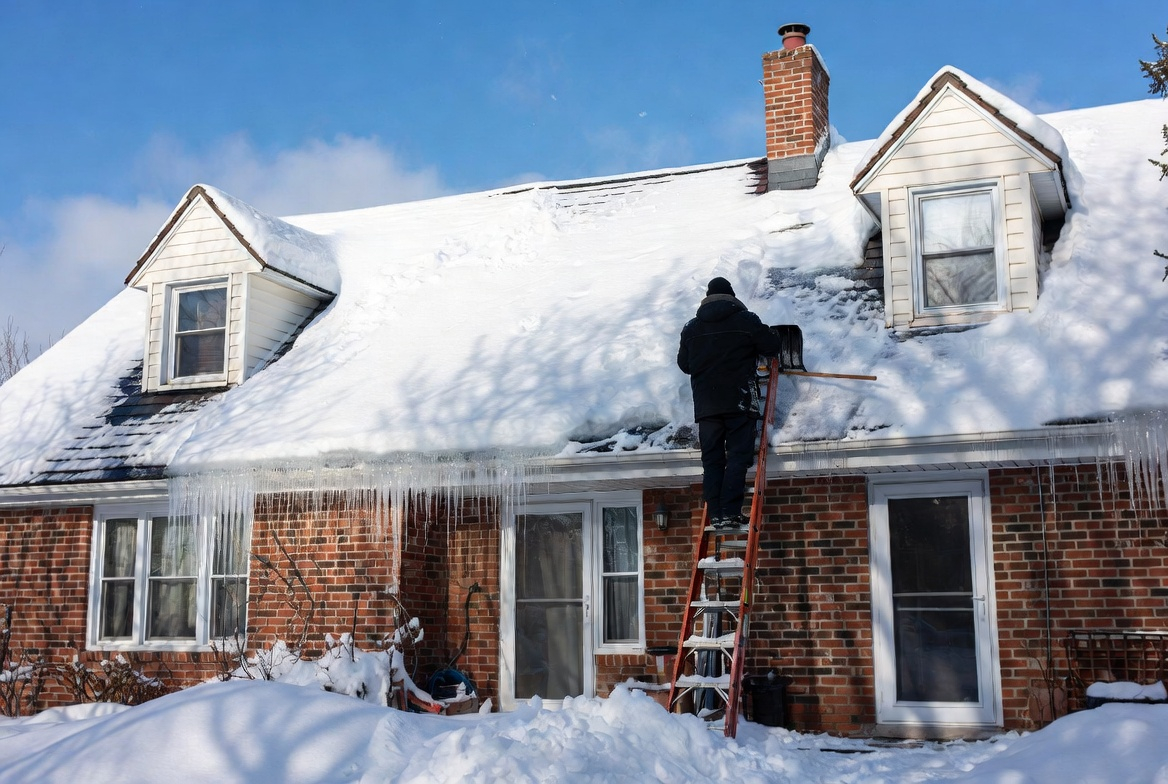
Blocked gutters filled with leaves and debris become ice dams in freezing conditions. The weight of ice and frozen debris can pull gutters away from the fascia, causing wall damp and structural leaks.
Insurance data from the Association of British Insurers consistently shows that household insurance claims spike by two to three times during and immediately after cold snaps. Escape of water — typically burst pipes — is the single largest source of household insurance claims in the UK, costing insurers over £1.8 billion per year. The vast majority of those claims are from incidents that were entirely preventable.
Burst Pipes: Costs, Prevention & What To Do Right Now
A burst pipe in winter is not just a plumbing problem — it is a property damage event. A 15mm copper pipe can release 400 litres of water per hour. Over a weekend when a property is unoccupied and the heating has been switched off, that is enough to destroy flooring, ceilings, plaster, electrics and personal possessions across multiple rooms. The plumbing repair itself may cost £200. The consequential damage can cost £20,000.
What Does Burst Pipe Repair Cost in the UK?
| Work Type | Typical Cost Range (2026) | Notes |
|---|---|---|
| Emergency call-out fee (daytime) | £80–£150 | Diagnosis and initial assessment. Usually deducted from repair total. |
| Emergency call-out fee (out of hours / weekend) | £150–£250 | Premium applies for evenings, weekends and bank holidays. |
| Straightforward pipe repair (accessible location) | £80–£200 | Cutting out the damaged section and replacing — typical burst pipe job. |
| Pipe repair (concealed in wall or floor) | £300–£800+ | Access, repair and making good. Labour-intensive. |
| Full pipe replacement (section of system) | £500–£2,000+ | Older lead or steel pipework in vulnerable areas. |
| Water damage restoration (minor) | £500–£2,500 | Drying out, replastering, redecorating a single room. |
| Water damage restoration (major) | £5,000–£25,000+ | Multiple rooms, structural drying, full decoration — insurance claim territory. |
The single most important thing you can do before any burst pipe occurs is locate and test your internal stopcock. It is typically under the kitchen sink, near the front door, or below the stairs. Turn it to ensure it moves — stopcocks that have not been operated for years can seize. In an emergency, every second before you can stop the flow of water is more damage. If you cannot find or operate your stopcock, call a plumber before winter, not during it.
How to Prevent Frozen Pipes
The good news is that the vast majority of burst pipe incidents are preventable. The bad news is that most homeowners take no preventive action until they have experienced the problem themselves.
- Keep the heating on a frost-protection setting when the property is unoccupied. Set to 12–15°C minimum, not off. The cost of background heating for two weeks is a fraction of the cost of a burst pipe and its consequences.
- Insulate exposed pipes in the loft, garage, and outside walls. Pipe lagging foam sleeves cost £2–£10 per metre and take minutes to fit. Pipes in unheated spaces — including where they pass through external walls — are highest risk.
- Drain outdoor taps before the first frost. Turn off the isolating valve inside (usually under the kitchen sink), then open the outdoor tap to release any remaining water. Outdoor tap insulating covers provide additional protection.
- Check that your loft hatch seals properly. An unsealed loft hatch allows warm air from the house to escape — leaving pipes in the loft exposed to outside temperatures. Fitting a draught-proof loft hatch takes under an hour.
- During a very cold snap, open under-sink cabinet doors. Pipes running inside external kitchen walls are at risk. Opening the cabinet doors allows warm room air to circulate around them.
- If you suspect a pipe is frozen, do not use a blowtorch. Use a hairdryer on a low setting, working from the tap end back toward the freezing point. Never apply direct flame — you risk fire, or causing a steam explosion inside the pipe.
Boiler Breakdowns: Emergency Repairs, Costs & When to Replace
Your boiler is the most heavily worked appliance in your home during winter — and the one you can least afford to have fail. Yet UK industry data consistently shows that over half of UK homeowners have never had their boiler serviced, and a significant proportion are running heating systems that are more than 15 years old. The result is predictable: heating engineers are overwhelmed every time temperatures drop sharply, and homeowners without a service plan can wait two to five days for a repair visit in peak winter periods.
Why Boilers Fail in Winter
The most common winter-specific boiler fault in the UK is a frozen condensate pipe. Modern condensing boilers (the standard type fitted since 2005) produce acidic condensation as a by-product of combustion. This condensate drains away through a plastic pipe, often running externally or through an unheated space. In freezing temperatures, this pipe can ice up — blocking drainage and causing the boiler to lock out on a fault code. The fix is usually simple: thawing the pipe with warm (not boiling) water. But finding a plumber who can visit quickly in the middle of a cold snap is the challenge.
If your boiler has stopped working and is showing a fault code during cold weather, check whether your condensate pipe (the external or semi-external plastic pipe, usually white or grey, running from the boiler to an outside drain) is frozen. Pour warm — not boiling — water over the pipe to thaw it, then reset the boiler. This resolves the majority of winter boiler lockouts and does not require a Gas Safe engineer. If the boiler still does not fire after thawing and resetting, call a registered engineer.
Emergency Boiler Repair Costs UK 2026
| Fault / Repair Type | Typical Cost Range (2026) | Time to Fix |
|---|---|---|
| Diagnostic call-out (daytime) | £80–£150 | 1–2 hours |
| Diagnostic call-out (out of hours) | £150–£250 | 1–2 hours |
| Frozen / blocked condensate pipe | £0 (DIY) – £120 (engineer) | 30 minutes |
| Pressure issue (re-pressurise & check for leaks) | £80–£180 | 1–2 hours |
| Faulty pump replacement | £200–£450 | 2–4 hours |
| Motorised valve replacement | £150–£350 | 1–3 hours |
| Printed circuit board (PCB) replacement | £300–£600 | 2–4 hours |
| Heat exchanger replacement | £400–£900 | 3–6 hours |
| New combi boiler (supply & install) | £1,500–£3,500 | 1–2 days |
| Annual boiler service (prevention) | £70–£120 | 60–90 minutes |
Should You Repair or Replace?
The standard industry rule of thumb is that if a repair costs more than 50% of the cost of a new boiler, and the boiler is more than 10 years old, replacement is almost always better value. A new condensing boiler runs at 89–94% efficiency; an older non-condensing unit may only achieve 70–80%. The energy saving alone can justify replacement within three to five years.
An annual boiler service costs £70–£120 and takes 60–90 minutes. A missed fault caught at a service costs nothing to fix at that point. The same fault ignored until it fails in December will cost £200–£600 in emergency call-out and parts, plus however many days of cold while you wait. The ABI estimates that homeowners with serviced boilers make 40% fewer emergency heating claims than those without. The numbers make servicing the single highest-return maintenance investment in your home.
Roof Damage After Snow and Ice: Inspection, Repair Costs & Timelines
Roofs are designed to shed water, not to support sustained loads of heavy, wet snow. A standard UK pitched roof in good condition can cope with light snowfall, but heavy, wet snow accumulating over several days adds significant weight — and the freeze-thaw cycle that follows is where most of the damage occurs.
The critical point is that roof damage from winter weather is almost never obvious from inside the property when it happens. A slipped tile, cracked flashing or lifted ridge tile may allow water ingress that saturates insulation, wets rafters and gradually works its way through to ceilings — over weeks or months. By the time an interior damp patch appears, the damage is substantially worse than it would have been had the roof been inspected promptly after the cold spell.
Post-Winter Roof Inspection: What to Look For
You do not need to access the roof yourself — in fact, getting onto a wet, potentially frost-affected roof is dangerous and should only be done by a professional. What you can do is a ground-level visual inspection using binoculars, looking for:
- Displaced or missing ridge tiles. The mortar holding ridge tiles (the capping tiles along the apex of the roof) degrades over time and is particularly vulnerable to ice expansion. Shifted ridge tiles are one of the most common post-winter roof repairs.
- Slipped or cracked slates or tiles. Look for tiles that are sitting at an angle or are visibly broken. Pay attention to valleys (where two roof slopes meet) — these are high-risk zones for water pooling.
- Damaged or lifted flashing. The metal strips that seal the junction between the roof and chimney stacks, dormer windows and walls are common failure points. Winter movement can lift or crack the mortar bedding that holds them.
- Sagging sections. Any visible dip or sag in the roof line warrants urgent professional inspection — it indicates possible structural rafter damage or saturated roofing felt.
- Indoors: damp patches, water stains, or musty smells in the loft. Go into the loft after every significant cold spell and look at the roofing felt for signs of moisture or staining that were not there before.
Roof Repair Costs UK 2026
| Repair Type | Typical Cost Range (2026) | Urgency |
|---|---|---|
| Re-pointing / re-bedding ridge tiles (per section) | £200–£600 | High — water ingress risk |
| Replacing individual slipped/broken slates or tiles (1–10) | £120–£400 | High if exposed felt visible |
| Flashing repair or replacement (chimney stack) | £200–£600 | High — common source of leaks |
| Larger tile section replacement (scaffolding required) | £800–£2,500 | Medium — assess extent first |
| Structural rafter repair (minor) | £500–£2,000 | Urgent — structural safety |
| Roofing felt replacement (full roof) | £1,500–£4,000 | Plan ahead — major project |
| Full roof replacement (3-bed semi) | £5,500–£12,000 | Plan ahead — major project |
| Professional roof inspection (report only) | £100–£300 | Recommended after any severe cold |
After every significant snowfall or storm, teams of unsolicited traders — commonly called "storm chasers" — drive through UK neighbourhoods offering on-the-spot roof repairs to homeowners they claim to have noticed have damage. These operations are among the most prolific sources of cowboy builder complaints in the UK, with Trustpilot and Citizens Advice regularly warning about them. If your roof genuinely needs attention, find a verified roofer independently. Never agree to work from someone who knocks on your door.
Gutters & Drainage: The Hidden Winter Risk Most Homeowners Ignore
Gutters sit at the intersection of almost every winter risk category: blocked gutters cause roof damage, damp penetration into walls, saturated foundations, and flooded basements. They are also the most neglected exterior maintenance item on a typical UK home. Most gutters are never cleared from the day a house is built until the day the owner notices a problem — which is typically years after the damage has begun.
Gutters clogged with leaves, moss, and debris do not drain effectively. In winter, standing water in blocked gutters freezes — expanding and cracking plastic guttering, pulling brackets away from fascia boards, and creating ice dams that force water back under the roof edge. The ice weight can pull an entire section of guttering away from the house, leaving a gap through which water runs freely down the wall.
Gutter Clearing Costs UK 2026
| Property Type | Typical Gutter Clearing Cost (2026) | Frequency Recommended |
|---|---|---|
| Terraced / end-of-terrace house (1 or 2 storeys) | £60–£100 | Twice per year |
| Semi-detached house | £80–£140 | Twice per year |
| Detached house | £120–£250 | Twice per year |
| Gutter repair (replacing a cracked section) | £80–£180 per section | As required after inspection |
| Full gutter replacement (semi-detached) | £400–£800 | Every 20–30 years (uPVC) |
| Downpipe clearing (per pipe) | £40–£80 | With each gutter clear |
Twice-yearly clearing — once in late autumn after leaves fall, and once in early spring after winter debris accumulates — is the industry standard recommendation. The cost of two gutter clears per year runs £120–£280 for a typical semi-detached house. The cost of the damp penetration and wall repairs caused by a blocked gutter failing over several years can be £2,000–£8,000.
Driveways, Paths & External Areas: Safety, Damage & Clearing Costs
Snow and ice on driveways and paths are both a safety risk and a source of longer-term surface damage. Freeze-thaw cycles are particularly damaging to older block paving, tarmac, and concrete surfaces — water infiltrates small cracks or the joints between blocks, freezes, expands, and progressively breaks down the surface.
Salt and Grit: What Works, What Damages
Rock salt (sodium chloride) is effective at melting ice and snow but causes accelerated corrosion of metal (including car bodywork, gates, and ironwork) and can damage certain types of block paving sealant over time. It is also harmful to lawns and plants if spread widely. Sand provides grip without these issues but does not melt ice — it simply provides traction. For most domestic driveways, a combination of rock salt for ice clearance and sand for grip on cleared surfaces is standard practice.
There is no legal requirement in England, Scotland or Wales for homeowners to clear snow from public pavements outside their property. However, you will not be liable for injury if you clear a path and someone slips — provided you do so carefully and with proper grit or sand. The outdated advice to avoid clearing for fear of liability is incorrect. Government guidance explicitly encourages homeowners and businesses to clear snow and grit paths outside their properties.
Driveway Damage Repair Costs
| Repair Type | Typical Cost Range (2026) | Notes |
|---|---|---|
| Block paving re-pointing (per sq m) | £15–£35 per sq m | Fills frost-damaged joints |
| Tarmac crack repair (minor) | £80–£300 | Cold-pour sealant or patch |
| Concrete path crack repair | £100–£400 | Resin injection or cementitious repair |
| Full driveway resurfacing (tarmac, 40 sq m) | £1,500–£3,000 | Major works — plan in spring/summer |
| Professional snow / ice clearing service (one-off) | £50–£150 | Residential — varies by area and coverage |
Insulation & Heat Loss: The Long-Term Winter Fix
Emergency repairs address the consequences of cold weather. Insulation addresses the cause. A poorly insulated UK home loses between 25–35% of its heat through the roof, 30–35% through walls, and 10–15% through the floor. These are not theoretical numbers — they represent real money leaving your home every hour during cold weather, and they directly increase the load on your heating system and the risk of boiler failure.
Insulation Options and 2026 Costs
| Insulation Type | Typical Installed Cost (2026) | Annual Saving (Est.) |
|---|---|---|
| Loft insulation (top-up to 270mm, 3-bed house) | £300–£500 | £150–£300 per year |
| Cavity wall insulation (3-bed semi) | £400–£800 | £150–£250 per year |
| Solid wall insulation — internal (per room) | £1,500–£3,500 per room | Substantial but variable |
| Solid wall insulation — external (full house) | £8,000–£20,000+ | £200–£500 per year |
| Floor insulation (suspended timber, 3-bed) | £1,200–£2,500 | £50–£100 per year |
| Draught proofing (doors, windows, letterbox, loft hatch) | £200–£600 (professional) | £50–£150 per year |
For most Scottish homes, loft insulation and cavity wall insulation (where the property has a cavity) represent the most cost-effective interventions — often paying back their installation cost within two to four years. The Great British Insulation Scheme and ECO4 scheme may offer partial or full funding for eligible households; check eligibility at gov.uk before commissioning private works.
Scotland's Specific Risks: Why This Matters More in Glasgow & the North
Scotland experiences a more severe version of UK winter property risk than most of England. Glasgow averages 25 days of air frost per year; Edinburgh averages 32 days. Aberdeen and the Highlands see far more. But temperature alone is not the full picture — Scotland's combination of high rainfall, regular freeze-thaw cycles (rather than sustained freezing), older housing stock, and higher rates of pre-1919 solid-wall construction creates a specific and demanding winter maintenance environment.
Over 40% of Scotland's homes were built before 1945, and a significant proportion are granite, sandstone or render-over-stone construction with solid walls — making cavity wall insulation irrelevant and making damp penetration through the wall face a greater risk than in modern cavity-wall properties. Pre-1919 tenement flats present particular challenges: shared closes, common roof areas, and communal drainage systems mean individual remediation is often complicated by factors outside a single owner's control.
Specific Scottish Winter Maintenance Priorities
For Scottish homeowners, the following are the highest-priority maintenance items given local conditions:
- Chimney maintenance. Many older Scottish properties retain original chimney stacks that are no longer in regular use. Unused chimneys with open flues become significant sources of cold air infiltration and damp penetration. Fitting a chimney balloon or capping unused flues should be an early winter priority.
- Stonework repointing. The mortar pointing between sandstone and granite blocks is a critical barrier against water ingress. Freeze-thaw action accelerates mortar degradation in Scottish climates. Annual inspection and spot repointing is essential — failed pointing left unaddressed for several winters can cause progressive structural damp problems.
- Roof valley maintenance. Scottish weather drives more water across roofs more consistently than most of England. Keeping valleys free of debris and ensuring lead or felt valley liners are intact is a higher priority than in drier climates.
- Condensation management. Scotland's climate — cold outside, heated inside — creates strong condensation gradients in older solid-wall properties. Adequate ventilation in bathrooms and kitchens, and understanding the difference between condensation damp and penetration damp, is essential knowledge for Scottish homeowners.
The Complete Winter Home Maintenance Checklist
Use this checklist each autumn to reduce your winter repair risk. The items are ordered by priority — start at the top and work down.
-
1
Book your annual boiler service
Book in September or October — before engineers get busy. Confirm the engineer is Gas Safe registered. A service takes 60–90 minutes and costs £70–£120. It is the highest-return maintenance investment in your home.
-
2
Clear gutters and check downpipes
Late October to November, after leaves have fallen. Ensure all gutters are free of debris, downpipes are clear, and there are no leaking joints. If gutter sections are cracked or pulling away, replace before winter.
-
3
Inspect the roof (from the ground or professionally)
Look for slipped tiles, failed pointing on ridge tiles, and visible cracking around chimney flashings. If you have any doubt, commission a professional inspection — £100–£300 for a report is far cheaper than discovering a problem in February.
-
4
Locate your stopcock and check it operates
Find the internal stopcock (typically under the kitchen sink, by the front door, or below the stairs) and turn it to confirm it moves freely. If it is seized, have a plumber look at it before winter.
-
5
Insulate vulnerable pipes
Fit pipe lagging to any exposed pipework in the loft, garage, or external walls. Check outdoor tap isolating valves and drain outdoor taps. Cost: under £50 in most homes.
-
6
Check the loft hatch seals
An unsealed loft hatch allows warm air to escape, leaving loft pipes exposed to outside temperature. Fit a draught-proof loft hatch lining if one is not already present.
-
7
Service your heating controls
Check that thermostatic radiator valves (TRVs) are moving freely — they can seize if not adjusted regularly. Set frost protection settings on programmable thermostats. Check that all radiators heat up evenly; bleed if cold at the top.
-
8
Check external masonry and pointing
Particularly important in Scotland. Look for missing or cracked mortar joints in brickwork, stonework, and chimneys. Have a builder attend to any failed pointing before the first frost.
-
9
Review your home insurance coverage
Check that your policy includes escape of water cover and confirm that your sum insured is adequate for rebuilding costs at 2026 prices. Many homeowners are significantly underinsured. Review annually.
-
10
Have a plan for emergencies
Save the number of a verified local plumber, heating engineer, and roofer before you need them. In a genuine emergency in cold weather, searching for a tradesperson under pressure produces poor decisions. GetMaster allows you to find and pre-vet local professionals before a crisis occurs.
The Most Common Mistakes UK Homeowners Make in Cold Weather
The pattern of winter home damage across the UK is remarkably consistent year after year, because the same mistakes are repeated year after year. The following are the most costly — and the most avoidable.
"We went away for Christmas and turned the heating off completely. When we came back, a pipe in the loft had burst. By the time we found it, water had been running for at least three days. The ceiling in two bedrooms had come down. The insurance paid out, but we were out of the house for six weeks and the excess was £500. The boiler had been serviced and the pipes were fine — we just didn't leave the heating on."
- Turning the heating off completely when leaving the property. The most common cause of burst pipe claims in the UK. Keep the heating set to 12–15°C minimum, always.
- Ignoring small roof issues after winter. A single slipped tile costs £60–£150 to fix in spring. Left for another winter, it becomes water damage to rafters and insulation — now a £2,000+ repair with roof access charges.
- Accepting a knock at the door from a roofer or builder after a storm. Storm-chasing cowboy builders are one of the most reported scams in the UK after severe weather. Never commission work from an unsolicited knock. Always find tradespeople independently through a verified platform.
- Not knowing where the stopcock is. This one is remarkable for how common it is. In a burst pipe emergency, the difference between shutting off the water in 30 seconds and searching for ten minutes is thousands of pounds in damage. Every household member should know where it is.
- Skipping the boiler service because "it was fine last year." Boiler components fail progressively. A service catches the issue before it becomes a December emergency. Missing one year usually gets away with it; missing several years builds up risk exponentially.
- Leaving gutters blocked year after year. Gutter clearing is the most deferred maintenance item on UK homes and the one whose consequences — wall damp, structural moisture, foundation issues — are the most expensive and slow-developing. Clear them twice a year, consistently.
Where GetMaster Fits In
Cold weather emergencies have one thing in common: they happen fast, under pressure, and when you are least prepared to make good decisions about who you trust with your home. GetMaster exists to take the risk out of that moment — before it arrives, and during it.
Pre-Verified, ID-Checked Tradespeople
Every plumber, heating engineer and roofer on GetMaster has been verified before they appear in your search results. Gas Safe and WaterSafe registration is confirmed, not assumed.
Real Reviews From Real Jobs
We publish genuine, verified reviews — not curated testimonials. You can see how a tradesperson has handled previous emergency jobs and how they communicate when things get difficult.
Transparent, Itemised Quotes
Emergency situations are where opaque pricing is most abused. GetMaster professionals provide itemised quotes — call-out fee, labour and parts separated — so you know exactly what you are agreeing to.
Support If Things Go Wrong
If a GetMaster professional causes a problem, we are part of the resolution — not a directory that disappears after the introduction. In a winter emergency, that accountability matters.
Fast Local Matching — Including Scotland
We match you with professionals available in your area and within your timeline. For Glasgow and Scotland, our local network means faster response and better local knowledge of Scottish construction and housing types.
Book Ahead, Not in a Crisis
The best time to find your emergency plumber is before you need one. Browse and save verified professionals for each trade before winter — so when the call needs to be made at 11pm in December, you already know who to call.
We cannot make the weather warmer or pipes stronger. What we can do is ensure that when cold weather creates a problem in your home, the professional who turns up is who they say they are, charges what they said they would charge, and is accountable if they do not deliver.
Frequently Asked Questions
Don't Wait for a Winter Emergency
GetMaster connects you with ID-verified plumbers, heating engineers, roofers and maintenance tradespeople across the UK — with real reviews, itemised quotes, and support if something goes wrong. Find your local professional before the cold snap arrives, not during it.
Rated 4.9/5 · ID-Verified Professionals · No commitment required · Based in UK